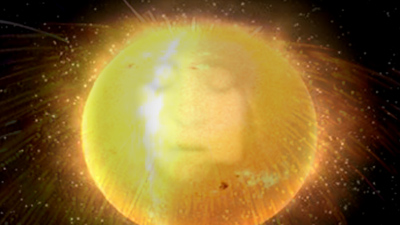
Here's a film that was an official selection at the Slamdance Film Festival in 2009, Zero Film Festival L.A. and True West Cinema Festival in 2008. It Shines and Shakes and Laughs was made by Matthew Wade. He shot this on Super 8 mm color reversal stock. There's an easy unhinged nightmare quality to the film which ultimately turns into an expression of fear of domesticity, I think. That engagement ring against the clouds is my favorite shot.
You can watch in resolutions of 360p, 480p, 720p HD, and 1080p HD. I think the best compromise for quality and loading speed is the 480p resolution. You can also watch it in HD on Vimeo.
I may do a part two of this film. For now, this is the film in full.
The film is science fiction because it concerns the use of memory images for time travel. The powerful imagery of the singular event - the horrific event - is etched forever in the mind, yet it becomes fluid and its influences cannot be entirely trusted. What led up to the singular powerful event? What course was set following it? In what way would the entire world be different if the event had been avoided or not seen? Not recorded? If, as scientists say, the fundamental particles of existence change location or cease to exist when observed or not observed, then what about events in memory? Or events simply residing in the past?
If one asks, 'Why are we here?' Well, I think the answer is obvious. We are here to remember things. We are memory.
It's difficult to see a star clearly if one looks straight at it. Looking just off to the side can clarify the star in one's perception. Going back in time to recover something lost is very much the same. One is sometimes forbidden to look directly at the object sought. One must keep one's gazed shifted slightly or risk losing the memory entirely. This principal has been understood for a long time.
So putting one's eye on something like a yellow plastic raygun, or a car, for example, might in fact sharpen one's vision and allow an accidental recovery or a transfer to take place.
Odd thoughts? Yes, well maybe so. Very much like the thoughts that run through one's mind before sleep completely obliterates consciousness.
The film uses a mash-up of archival footage, drawings, digital painting, new video and video I shot many years ago. The imagery is very layered and attempts to duplicate the way images move through my mind as I circle around my ultimate objective which is sometimes nearly unknown. There are a multitude of connections and meanings to be drawn from the sequence of images. Some meanings might be very obvious, others would be almost impossible to predict.
For Only Your Eyes. These images are from my upcoming Yellow Plastic Raygun. Distilling single frame images is almost as much fun as making the film. What kind of a film does it seem like?
My new film is a silent one about wet, foggy colors. It was raining in December and the roses looked droopy under the weight of the water droplets. Then the camera started going in and out of focus and I thought it made a good color show so I started to learn how to make it happen more and how to make the focus flutter. So I think that what is out of focus in the film is more important than what's in focus.
Here’s a new film for the film fans who happen to stumble by. It’s a film about memory shifts, searching, losing something, trying to find the old image, trying to regain an old feeling or impression, capturing a season of life or the mind. As if one were thinking, “I can almost remember how it was and what we did that day so long ago. Where were we again? North somewhere? It was dark? No, the sun was out… wait, it was cold… I think.
My latest is a landscape really. This one is a very straightforward abstraction. It's a view sort of seen in miniature - as if through a small aperture. The way you move by the same view over and over again without ever really seeing much. Blind on blind.
My latest little film. It's actually a cinegram. The subject is trains. Time. Memory. The present doesn't exist. You can't find it with measurement. You can't even define it. The future is not there yet. You cannot see it. The only thing that really exists is the past. I say that because we can all see the past - some more clearly than others. But we can most certainly see it.
Here's the poem from inside the movie:
Lunch With Bardot
Trains run on time With passengers asleep Temporarily forgotten Between observation points Colliding lines Of fictional transport
Philips has a new super-widescreen television coming out that is in true cinema proportions. This 'freeze-frame' film is their advertisement for it. It's a beautifully produced police shootout with a gang of clowns at a hospital. It's got obvious Joker overtones and is just so damn creepy and weird. Adam Berg is the filmmaker. As I watch it I wonder how they did it. You can go over to an interactive version and move through the film slowly. The techniques used become more clear that way. It's really one giant stitched-together image with some CG inserts. It really works.
DeK at No fat clips!!! has posted my latest film, Kingdom of Moderate Sunshine! I'm very proud of that because I think DeK runs the best cinema site on the internet. DeK finds films, understands them, finds excellent quotes to go along with them, and posts them in all sorts of formats for viewers to enjoy.
I go to No fat clips!!! all the time to see what filmmakers are up to around the world. This is the first time I've been included in the list of films there. Thank you to DeK at No fat clips!!!
You should make sure to press the 'HD' button to get the best image in the player if your connection can support the large file size.
I wanted to make the kind of film that might play on Winston Smith's telescreen in his Oceana home from George Orwell's novel, 'Nineteen Eighty-Four.' This thought was not in my mind at the start of making my film, but as I worked on it I began rereading the Orwell novel and realized that my instincts were following right along the lines of his thinking. The concepts of 'doublethink' and 'newspeak' came naturally to me as I began to assemble my film. I'm interested in the techniques and mind-control efforts of fascism. The use of expressions that are at once meaningless and obvious fascinates me. Orwell uses phrases like 'Ignorance is Strength' for his language of the Party. Once you start thinking along fascist lines and trying to create according to fascist mythology and will to power, it's pretty easy to come up with strange phrases like, 'True History Refurbishment.' That's one of mine from the film. The combining of this kind of language with images that play against each other in the same way creates an almost frighteningly fascist work.
I had originally set out to make a film that criticized the use of fascist art techniques for political purposes in the U.S. The primary example of this currently is the famous picture of Barack Obama by artist Shepard Fairey. The poster is powerful but strikes me as bizarrely fascist in its technique and focus on the hero personality gazing upward toward some grand future above all our heads. Pretty damned terrifying if you ask me. But I'm obsessed with the whole idea of it and what drives people to start using this kind of imagery. So I had wanted to make a short film that objected to this kind of thing. But as I worked, I realized that I had made a weak choice. Far better to make an actual fascist film from some mythological totalitarian state that had mastered all the methods of population and mind-control through sound and image. So that's what I did.
The dense layering of images that I used to create new compositions and emotions incorporates many different elements. I used original HD footage that I shot recently, artwork I created in Photoshop, computer-generated voices, machinima footage that I shot directly off of a plasma television screen while manipulating the game characters with an Xbox 360 controller, public domain government films, documentary footage, corporate films, images of graffiti, training films, porno films and old western films. I found that the wealth of footage freely available from Archive.org was my most valuable asset. It required many hours of searching and scanning for just the right shots for the impressions and meanings that I was interested in for my film.
So, yes, I have created a truly despicable bit of fascist totalitarian social training that tries very hard to convince the viewer to be a good working member of the 'Collective.' But the great thing about working this way is that the humor and unwitting self-criticism leaks out through every shot of the film. It's almost as if the repressive state trying so hard to convince everyone of its strength and noble cause, just can't help but make fun of itself without knowing it.
Since the film uses text so closely related to the images I've classified this as both a film and a cinegram.
Sita Sings the Blues is a feature animation by Nina Paley. It is based in part on the ancient Indian Ramayana, but combines this with stories from the animator's life. The film incorporates some 80-year old jazz music by Annette Hanshaw. Those recordings are public domain but the compositions are not and the owners will not allow Ms. Paley to sell the movie containing the copyrighted compositions. So public television, which operates under unique rules concerning copyright, broadcast the movie and offered it in full on their web site. Now, the animator has offered the film for free with a Creative Commons license in many formats, including HD.
It's a wonderful film that is bursting with color, enthusiasm and sheer raving talent. Enjoy it.
In film, we ignore our great thinkers and practitioners at great peril to ourselves. For my entire life, I rejected any consideration of Jean-Luc Godard. I dismissed him as a pretentious, dull intellectual who threw text around on the screen to hide bad filmmaking. I had seen 'Breathless' and had a memory of two people in vivid and somehow ultra-modern black & white climbing on top of each other and walking on a bed in a tiny apartment room. But I dismissed the director as a one-film-wonder and refused to see anything more by him.
Until one year ago.
I have been reading a good book about Jean-Luc Godard and watching as many of his films as I can find on DVD. He's still working. He's still there. I'm glad I managed to find him while he's still working.
I enter a room in mid-afternoon knowing that my camera is only a few feet away. The light comes through the kitchen window and makes shadows of potted plants on the white porcelain tile. The trees outside sway and it seems like rain is coming. I know that there are scenes I could film here. They are all around me in this room with its strange light. I could grab my camera and with the proper attitude make an incredible film. Right now. Immediately. But it's hard to do. It's a battle to persuade one's self to attempt it. I begin to feel foolish. I struggle with myself and laugh at myself for imagining that out of the great universal pile of YouTube videos a single film taken in my kitchen could possibly amount to anything at all in the mind of a single viewer. Nietzsche, in 'Thus Spake Zarathustra,' writes about how one's self is one's greatest enemy and will begin to doubt and mock one's own thoughts and noble efforts.
I view Godard as someone who has spent a lifetime leaping fully into this battle and winning it. He would look around my kitchen, pull out his video camera, turn a gas burner on and film it without a pot to heat. He might talk about holding his palm to the fire and then pressing it against his lover's cheek to burn her. He might briefly show a scalded and blistering hand, a palm print on a cheek, a car bomb exploding next to a busy marketplace. And he would have a film. I think he has fought consistently to make film a nearly mental act. As much a mental act as writing a novel or a poem. I think he is perhaps closer to this achievement than anyone else in the history of cinema. He appears to be willing to put himself into his work the way a writer might. Not a screenwriter. A real writer. I don't think Godard gives one tiny bit of a damn about screenplays. He uses a camera to write. Like Brakhage scratching celluloid with his fingernails.
Last night I watched 'Contempt.' I've read that Godard was unhappy during this shoot and couldn't stand working with Brigitte Bardot. But it's one of the greatest films about marriage that I've ever seen. She is magnificent in it. Mysterious and irrational and like a curse to all foolish and driven men. Once again, I come from a Godard film with a vivid memory of a man and a woman stalking each other in an apartment. Climbing over one another and scrambling across a bed. Almost like a prizefight. The film is forty-six years old and looks like it was shot just last week. Godard is the most modern of artists. I look at his work and I suddenly know what the word 'modern' means. It has nothing to do with being recent. I think it might be something to do with light and the way people behave in it and react to it. How they gaze at or through windows and engage with structures and how they move into or out of the light. Modern. Microsoft didn't name its operating system 'Windows' for nothing.
Here's a short film called 'Une catastrophe' that Godard made for the 2008 Viennale film festival.
Here's is a piece of his enormous 10-hour 'Histoir(s) du cinema.'
Well I certainly want to see all the rest of that. It's spellbinding. I like the way he talks about how Italy was the only country that could resist the domination by American film in the 1940s. How he says the language of Dante made its way into the image and made Italian cinema great. I believe him because the images make me believe him. I want DVDs of this history of cinema. I want them badly.
I got into a big fight in a movie theater this past Saturday night after seeing a Swedish film called 'Let the Right One In.' At the end, a friend of mine said, 'Boy! The pace of that was just unbearable.' I snapped, 'Forget every stupid thing you've ever heard about Hollywood films. It's a disease I recognize. The disease of timing. Timing. You think films need to blast along on a railroad track, gaining speed until the big crash at the end... don't you?'
I'm just that kind of asshole. Three of use made our way up Fairfax Avenue yelling at each other like several idiots. But I meant it and I'd say it again.
But see, Godard doesn't even think the railroad tracks exist. There's no train and there's no end.
So Godard now works in his studio with video equipment. I wonder if secretly, under some indecipherable username, Jean-Luc Godard might be uploading work everyday onto YouTube. Would he do that? Wouldn't it make sense? Perhaps he's shooting video in his kitchen everyday and making something magnificent for us to see. I want the link if it exists!
Are we mistaken in assuming that the whole vocabulary of abuse which is exhausted every week in the journals of our red and pink-complexioned comrades - the sneers against a man's talent, the bitter denials that his work has any substance, sincerity, truth, or reality whatever - is really what it seems to be? No doubt we are mistaken. It would be more charitable to believe that these pure spirits of the present day are what they say they are - collective, selfless, consecrated - and that the words they use do not mean what they seem to mean, and do not betray the romantic and deluded passions that seem to animate them, but are really words used coldly, without passion, for the purposes of collective propaganda - in operations completely surgical, whereby the language of the present day, with all its overtones of superstition, prejudice, and false knowledge, is employed clinically, scientifically, simply to further the Idea of the Future State!
No more, no more! Of what avail to crush these vermin beneath our heavy boot? The locusts have no king, and the lice will multiply forever. The poet must be born, and live, and sweat, and suffer, and change, and grow, yet somehow maintain the changeless selfhood of his soul's integrity among all the crawling fashions of this world of lice. The poet lives, and dies, and is immortal; but the eternal trifler of all complexions never dies. The eternal trifler comes and goes, sucks blood of living men, is filled and emptied with the surfeit of each changing fashion. He gorges and disgorges, and is never fed. There is no nurture in him, and he draws no nurture from the food he feeds on. There is no heart, no soul, no blood, no living faith in him: the eternal trifler simply swallows and remains.
And we? Made of our father's earth, blood of his blood, bone of his bone, flesh of his flesh - born like our father here to live and strive, here to win through or be defeated - here, like all the other men who went before us, not too nice or dainty for the uses of this earth - here to live, to suffer, and to die - O brothers, like our fathers in their time, we are burning, burning, burning in the night.
Thomas Wolfe ('You Can't Go Home Again' published in 1934)
Look at this. It's ragingly brilliant. It's a film called 'La Vida Nueva' by Kaymen Barber at the Echo Park Film Center in Los Angeles.
I love the shots going down the streets while shooting out of a car. Just wonderful. This film grabs attention and does not let go. It keeps hitting you with people who want to tell their stories to the filmmaker. You know, it's not easy to get people to want to tell you their story. Not easy at all. This Kaymen Barber has some serious talent and better not stop making movies because he's going to waltz himself straight into a professional filmmaking career and blow a few directors I know clear out of the pond.
It looks like the film is shot with a silent camera and then sound is recorded later. Frankly, I think the technique is totally captivating and it is something I never would have thought of. It's so good in fact that I want to steal it. That's how good it is.
Here's another film. It's called 'Thick Strings and Shredded Cheese,' by Carla Orendorff.
This is a young filmmaker learning fearlessly. She's good. This film is moving in a very simple and direct way. I love the shots of the photos and the spools of thread. The way the filmmaker animates them on the table. I've never seen that before. It's something new. To do that in the middle of a documentary with a voice telling a story is a very unique and wonderful approach.
Here's yet another. It's called 'Spray Cans and Stencils.' It's by John Tavares. It's about artists and what they do.
I think what you have here are three artists showing their respect for each other. The two spray can and stencil artists are doing their thing for the film artist and the sense of mutual understanding that comes through this film is very subtle but unmistakable. I love the quick shot of the painter taking a digital photo of his work on the wall. He is serious and proud. As he should be. This is a fascinating documentary that I wish lasted at least an hour because I want to see more.
I once had a big conversation with friends about how best to find real intelligence in kids aside from IQ tests and things like that. I said that if you want to find intelligence you go and hand cameras to kids and see what they make. That's one way you can find someone's mind. But I never had the will to prove it. It looks to me like someone down at the Echo Park Film Center is doing this and it's paying off. I haven't been down there yet, but I think it's a great place anyway. I can tell from the films.
This is a notebook stuffed with cinegrams, videos, poems, opinions, reviews and scraps.
A cinegram is a short motion picture that uses images and text that are packed with meaning and suggestion. It's my new word for things I once referred to as film poems.
Adjust contrast of a pdf free
-
Closer to the eye of the shooter, this is because Preview is quite
literally applying a filter to each individual page of the PDF you are
saving. the proce...
Made in the Shade
-
*by Steve Dollar*
[image: I Used to Be Darker]
*[Editor's note: due to budget cuts and internal restructuring, Steve's
review will likely be my final po...
Vimeo Autoembed Fixed
-
The mood is a harsh mistress Just noticed that the Vimeo autoembedding
script was broken due to an unhandled redirect. Fixed it. Also updated the
post for ...
Jagged Line Blog Moves to CandlelightStories.com
-
The Jagged Line posts are being moved to their mother-ship,
CandlelightStories.com. We've put together a nice new site design that is
fully blog-oriented b...


 Dream Road
 Crosswalker
 The Way Back Home
 Tap That
 Love Lights
 Going Deep
 Bang the Thing
 Any Kind of Spaceship
 Incoming